What Are We Here to Bring Into Being? A Personal Exploration of Why a Statement of Purpose Belongs in an Individual’s Holistic Context
by Andrea Malmberg
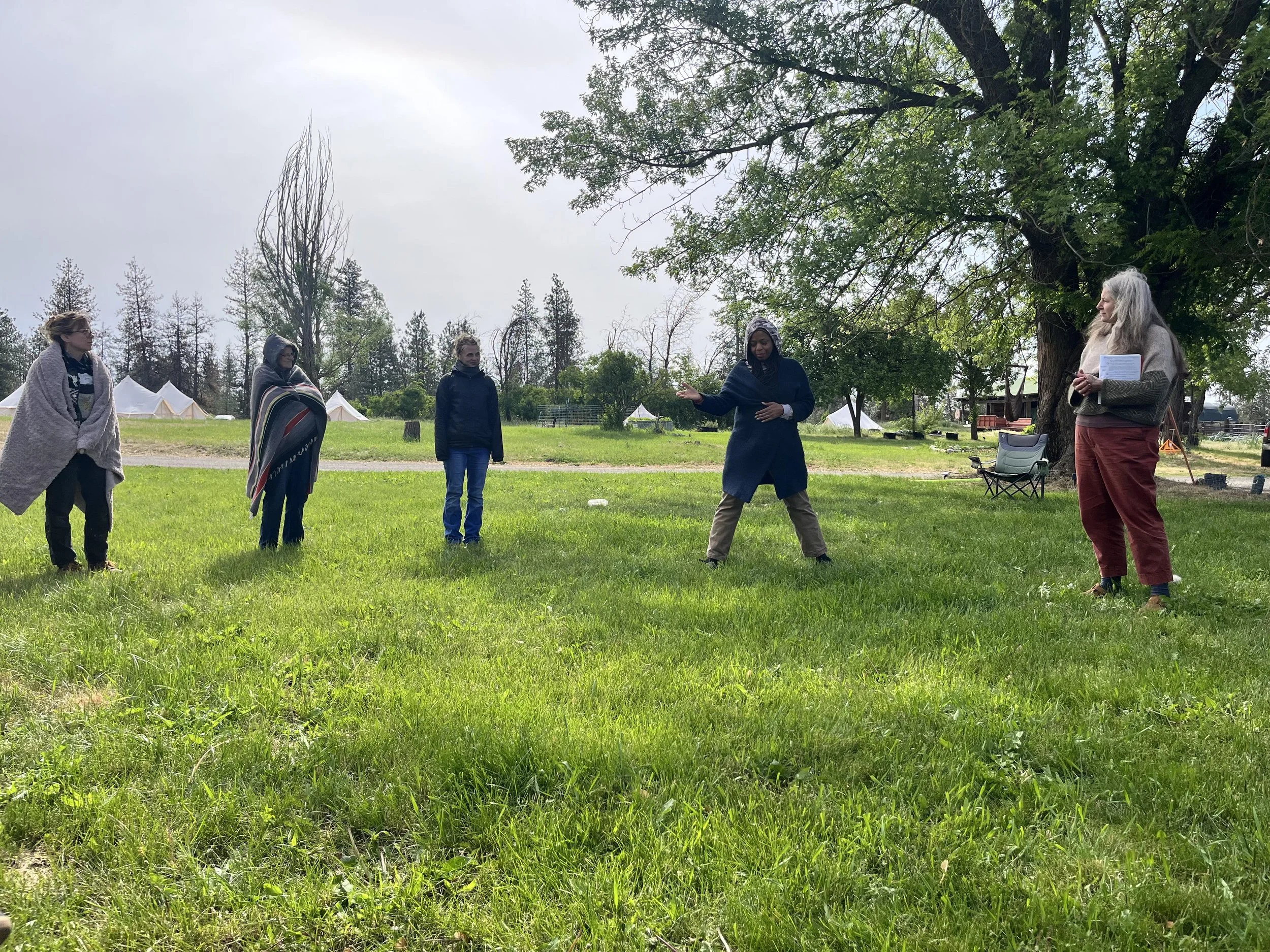
At a Cowgirl Camp devoted to somatic holistic decision-making, I posed a question: Do I, as an individual, need a statement of purpose?
One woman, who is in the practice of holistic decision-making, answered without hesitation: “You definitely need a statement of purpose!”
This departs from the way a statement of purpose is generally described in Holistic Management, where it applies to an organization formed to do something specific. An agency needs one because it must reflect the public purpose for which it was created; a cooperative might exist to provide business services, market access, and research to its members.
A family ranch is less straightforward, and an individual even more so. We were born, not incorporated. Our lives were not established under charters, and I question the need to justify existence through conventional standards and norms of usefulness and productivity. Yet a statement of purpose may still offer orientation if we change the question. Rather than asking, “Why was I formed?” we ask: “What am I responsible for bringing into being, in relationship with whom, and in service of what?”
The expressed certainty, “You definitely need a statement of purpose,” led me back to my Holistic Context. As I reflected, something unanticipated happened: a chronic, intense pain in my lower back moved to my knee. I so wanted to take some ibuprofen to cover up the root cause and go for a walk, but instead I sat uncomfortably on the ground and created a statement of purpose. What happened next is that the inflammation disappeared. I do not claim to know what occurred, but my body appeared to register something before my mind had fully understood it.
For now, my own statement of purpose reads: “To steward a place with an understanding that it is a protagonist. In collaboration with it, we are a force for unity, nurturing convivial relationships between people, land, and livelihood, creating the conditions for dignity, prosperity, belonging, and the full expression of life.”
The statement has helped me see the connective tissue among the ranches I steward, the work I do, the people and animals with whom I share my life, and the future I could no longer picture as I once had. More importantly, the experience opened a question that may be useful: Can a statement of purpose help an individual orient the complexity of an ever-changing life?
Being amongst a group of women, exploring how our decisions fit within our bodies, I began to contemplate that purpose might emerge through relationship. In WEIRD culture (Western, Educated, Industrialized, Rich, and Democratic), the language around purpose turns inward, encouraging the discovery of a singular passion, personal brand, or a calling hidden somewhere inside us. Yet, lives do not tend to unfold that way. Clarity may emerge instead through relationship—with people, place, work, history, other species, and the possibilities our choices either enlarge or foreclose.
Calling place a protagonist may help correct the tendency I feel, and I witness with others: when responsibility feels heavy, we begin to act as though everything depends upon us, as an individual. The land I steward tells a different story. Its soils absorb water or shed it; its plant communities gather solar energy and respond to management; its creeks carry the consequences of decisions made upstream and along their riparian areas; livestock shape the land, and the land shapes their health and behavior. People arrive with knowledge, labor, needs, loyalties, trauma, conflicts, courage, and imagination.
A Statement of Purpose May Give One’s Quality of Life and Finances Somewhere to Land
In Holistic Management, monitoring of the land, livestock health, and finances is essential. However, until LifeEnergy.Guide was created, Holistic Management practitioners didn’t have a way to check out how their stated quality of life was faring. Within the seven domains of well-being (prevalent emotions, vitality, satisfying life, self-actualization, personal resources, supportive relationships, and trust and belonging), an inquiry helps us reveal which dimension of life may be quietly consuming the others. Each domain continually influences the others. Meaningful work can justify depletion for a long time. Competence can conceal loneliness, and we can mistake endurance for justifying that a decision is sound even when health, finances, or relationships are telling a more complex story. Stewarding a flourishing landscape can give meaning to labor; convivial relationships deepen belonging and make collaboration possible; personal resources—including knowledge, financial capacity, practical ability, courage, and discernment—allow us to respond rather than merely endure. When depleted, we bring a thinner quality of attention to the land and people around us. When thriving, more perception, patience, and creativity become available. The condition of the land, animals, enterprises, and relationships affects us in return.
The Holistic Financial Planning process can then take our desired quality of life and future resource base and make a realized home for abundance, prosperity, and resilience by giving money work to do. Profit is planned before expenses consume it; investments intended to generate wealth are distinguished from costs that maintain usual patterns; expenditures are considered according to whether they move us toward what is described in our Holistic Context. This does not make money sacred or suggest that a welcoming attitude can overcome inequity, debt, illness, or bad luck. It means tending to what does arrive with intention and integrity.
Vicki Robin and Joe Dominguez wrote in Your Money or Your Life about reclaiming our lives by changing our relationship with money. Holistic decision-making adds another dimension: money can be directed toward the life described in our Holistic Context, while the planning process makes both limitations and possibilities visible.
That visibility is not always comfortable. Imagining that quality of life and future resource base may feel easier than deciding what will no longer receive funding. Yet wealth includes more than money: healthy soil, captured solar energy, effective water cycling, knowledge, time, capable people, trust, and the relationships through which we decide to put these resources to work.
A Statement of Purpose to Harness Self-Trust
Since Tony, my husband of twenty-seven years, passed, I have become the sole decision-maker within my personal Whole Under Management. I remain surrounded and influenced by people who care and collaborate with me, yet most responsibilities are mine. At times, that feels liberating; at others, profoundly lonely. A statement of purpose cannot replace my life partner or resolve that loneliness, but I’m finding that it helps me locate myself amid the responsibilities that remain.
Years ago, I made what I now think of as an integrity commitment: do what I say I am going to do. It sits heavily in “how must I behave” within my Holistic Context. Keeping my word to others comes more readily than keeping commitments to myself, such as eating well, exercising, or going to bed at a reasonable hour, since, really, no one else is watching most of my behavior now. However, getting back into the habit of recording my follow-throughs in LifeEnergy.Guide has made these discrepancies difficult to ignore.
This practice revealed self-trust as a resource — the practice is to make commitments with others and, importantly, ourselves deliberately, follow through reliably, and communicate honestly when circumstances require something different. I’m finding that self-trust, by creating a statement of purpose, appears to grow through smaller evidence: a call made when promised, money directed to the priority already chosen, rest taken before exhaustion consumes us, or a difficult conversation held before silence hardens into avoidance. Each kept promise creates a little more capacity for the next.
Without purpose, follow-through can become arduous in completing tasks that do not belong to the life we are trying to create. Purpose helps identify the promises worth making. Self-trust helps us keep them. Financial planning directs resources toward them, and collaboration enlarges what may become possible.
I somehow find habits and routine repellent. They take away from human creativity based on the observations and changing circumstances that every day presents. There was no way that it would be healthy for me to do a typical evening walk last night with a 500 air quality index. But my statement of purpose, built on self-trust, is helping me take care of myself so I can be there for all who are part of my place and contribute to what I’m bringing into being.